City Boy
Even with the provincial backgrounds of my parents, for as long as I can remember, I have been living in the city my entire life. I was born in Mandaluyong, lived in Cainta for around 9 years and have been living in Quezon City for the past 9 years. Living in the city entailed that the people I normally interact with also came from and was accustomed to the city life. A major factor in growing up in the city would be the prevalence of English when talking with other people, especially in the school setting or even out with friends, though this does not necessarily mean that Filipino was completely overridden.
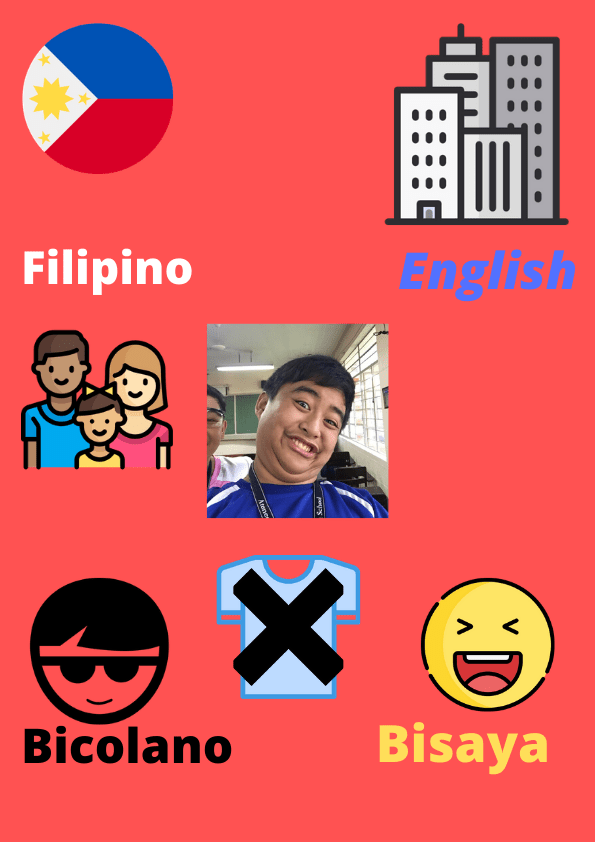
Bicolano
My father Originally came from Bicol and so from time to time, we would go there to visit some relatives. And during those visits, my dad would primarily talk in Bicolano along with our relatives and as a kid, I was not able to fully understand most of what they were saying. Eventually, through inferring and context clues, I picked up the meaning of some phrases and words, some were right and some were not. Occasionally, while eating together at the table, my dad would also talk in Bicolano and as I grew older, I found that even though I may not know the exact translation of those words, I understood what my father was saying without having to think about the words he used. My Bicolano side is more of a rough kind of personality, rough in the manner of speaking, rowdy in interacting with others, etc which I got from cousins there, this of course took some time in adjusting.
Bisaya
Like my father, my Mom also came from the province, specifically General Santos City. The case with her is very similar with my Dad. When we’d get the chance to, we would visit our Grandparents and cousins back in Gensan and as you’d expect, our relatives there spoke to us in a mix of Bisaya and Filipino. I eventually picked up these words and started using some of them at home. It was also very common for my Mom to speak in Bisaya at home and so to some degree, I am able to understand people when they speak in Bisaya given that there are enough context clues. My Bisaya side is more of a ‘joker’ and really values the presence of relatives.
Filipino
Out of all my identities, the one that I would say is engaged at all times regardless if I’m in the city or province would be my Filipino-self. This would pertain to the common behaviors present in most if not all Filipinos, like camaraderie, being hospitable to guests, strong ties with the family and to religion, our ‘hugging’ culture, and certain actions that we do such as using our lips to point, ‘pagmamano’, and among other things within the Filipino culture.
How are my identities congruent with one another?
Being somewhat exposed to Visayan and Bicolano culture throughout the years, I think that I’m able to encompass both identities at the same time when eating with my family. Like I mentioned before, both my parents use their provincial tongues when speaking to us at the table, and because of my upbringing in both cultures, I am able to understand both of them, even their tones. By tones I mean that I can decipher whether they are being sarcastic, serious, or trying to make a joke, which is slightly varied from how it would sound like if it was in Filipino or in English. This hybridity is especially useful at family gatherings wherein relatives from both sides come together. Naturally, I would have to ‘mano’ to all the elderly, uncles, aunties, even family friends which goes back to my Filipino culture of showing respect and importance to family members. There would be separation between the two groups, and it is at those times that I am able to switch between my Visayan and Bicolano identities when speaking to a particular group of relatives. Another instance wherein I am able to combine my identities would be when it comes to food. Being exposed to different dishes of different cultures, I would’t say that I am able to ‘adjust’ my taste buds, but rather I am able to accept and appreciate both cultures in terms of their food. Essentially, I am able to combine both my Visayan and Bicolano side under one identity, my ‘Provincial’ self. I am also able to utilize this ‘provincial’ identity when speaking to certain people at school. Whenever I hear people, more commonly the dormers who came from the provinces, speak in their native tongue (Most are visayans, only a few are bicolanos) , I feel a sense of camaraderie and belongingness with them. This is somewhat related to the Filipino culture of ‘pakikisama’ and ‘makabayan’ which is common among Filipinos who meet abroad or places outside of their homes and feel a sense of familiarity with each other.
How are my identities at odds with each other?
I think that my two identities that most frequently clash with one another would be my City Boy and Provincial identity. This is because growing up in the city, I have grown accustomed to the certain actions and practices that do not coincide with some beliefs I learned during my visits to Bicol and Gensan. An example of this would be the act of spitting on the ground. During my time in the provinces, it was common for people along with my relatives to spit on the road, grass, anywhere outside their home and they saw this as a mundane thing. They did not see anything wrong with this and was widely accepted by most. This however, contradicts with my upbringing in the city. In the city, this act would be seen as unhygienic and rude and being raised there my whole life, I have a natural bias against spitting in public. Another practice that was common in the province was the act of being shirtless. Probably because of significant lack of air conditioning back at the province, more people were more likely to take of their shirts whether at home or outside (this applied only to men). Again I saw this practice being done by my uncles and cousins. This however, is less common and somewhat frowned upon in the city especially in public areas. Another instance where the two identities collide would be when I’m talking with people who grew up in the city with little to no knowledge about the Visayan or Bicolano language. Since I am accustomed to speaking in broken Filipino-Bicolano-Bisaya at home, I sometimes have ‘slips’ when talking to company where I insert certain provincial words or slang and it ends in confusion.
 Chavit's Blog