Be yourself; Everyone else is already taken.
— Oscar Wilde.
This is the first post on my new blog. I’m just getting this new blog going, so stay tuned for more. Subscribe below to get notified when I post new updates.
Be yourself; Everyone else is already taken.
— Oscar Wilde.
This is the first post on my new blog. I’m just getting this new blog going, so stay tuned for more. Subscribe below to get notified when I post new updates.
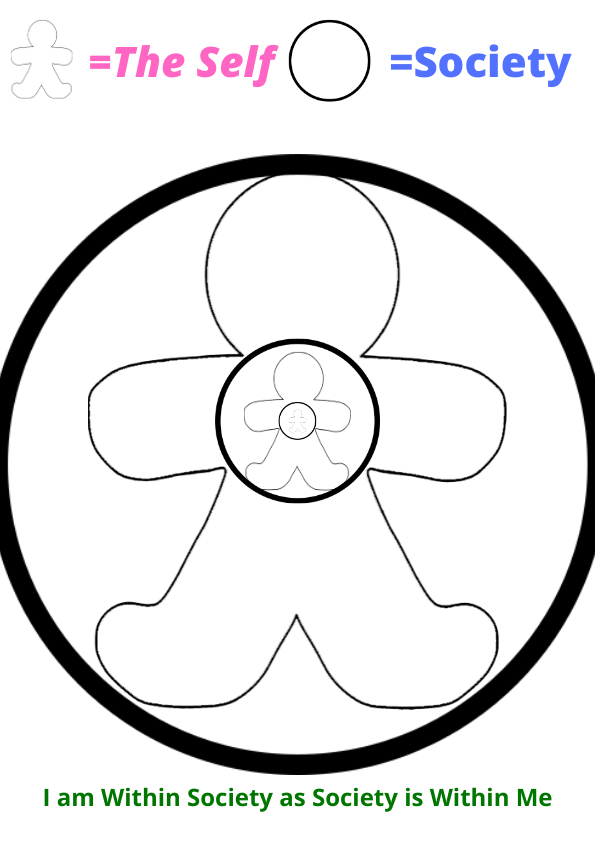
Going back to the time before undergoing the classes in SocSci, I used to view the world, people, society, others, and myself with a black-and-white lens. Despite this, something within me knew that things were not that simple, the world around and within me is much more complex than it seems, though I did not exactly know the deeper details as to how it was complicated. But slowly throughout the semester, I realized a few things about myself, the society or should I say societies I live in, and how these said societies and structures helped me in forming who I am today. For starters, I came to realize that I am part of a continuously globalizing world which entails that I cannot come to understand myself without understanding what it means to be a part of the globalizing community. I have a deeper understanding now of ‘who I am’, that there is not a single Chavit per se, but multiple identities, hybrid identities of myself that I can tap into whenever I see it fit for the environment I’m currently in, environments that gave birth to my identities. This is why I’m able to fit in multiple crowds and have varying cliques. Through taking a step back and looking more closely at my surroundings, I found that Society in general very much act the same way as bioecological systems, wherein in its complexity, in can be broken down into smaller subsystems. Societies are in a constant dynamic process wherein it continuously evolves and shapes me into the being I am, and in turn, I am able to contribute to how the structures within it are formed. But these societies are not limited to the real-life sphere, but also the digital field. I am able to portray a different side of me in the Online sphere given the relative freedom I have to pick how I want to be seen and which identity I want to utilize, this can be seen in my meme. Furthermore, I learned that at different stages in life these said structures, especially family, affect me differently in forming my identity/ies. I as a whole is created, formed, and molded by the realities, social structures, and cultures around me and as I continue to evolve, my contributions to those that preceded my being also change. But beyond that, I also saw that my understanding of myself is not as complete without the understanding of others. Through studying the concept of socialization, I am now able to question myself whether or not is who I am really who I am, or is it the manifestation of how others label me, and are the people around me really who they are or are they just acting in accordance to my personal perceptions of them? Lastly, I realized just how much an impact society and structures can bring to my Habitus as it is an embodiment of my social location. This goes back to while social structures do continue to mold me and evolve, it is through its influences that some aspects are maintained, and it is through my manifestation of those aspects that perpetuate the social structure that birthed my Habitus in the first place. Finally, I learned that even if I am shaped by the circumstances that surround me, I am not limited to what the world labels me as, and as a member of that world, I am able to go beyond my seemingly ‘defined’ self alongside others and it is I and they who make up the concept of each other’s selves. And so as I end my paper, I think it is important that people understand that one can never truly know oneself completely as the road going there is long and complex and its finish line is constantly changing positions or maybe there isn’t a finish line to begin with.
Malaika’s Perspective of me:
1. you’re insanely good looking 😉
2. you know how to calm me down, i don’t know how but you’re so attune to what i need (empathetic)
3. you’re crazy smart and idk why you always turn to me for help kasi kayang kaya mo naman (sometimes i feel stupid but idk if that’s because i’m intimidated or i’m just insecure)
4. hmm i don’t think you handle stress very well but that’s okay. i just wish i knew how to help you or calm you down but i know we’ve learned to work and all.
5. you’re a really good person. i know you’re all gago especially to your friends but i think one of the things i love most about you and that i’ve always loved about you is that you’re really caring and it doesn’t necessarily show upfront. you see that really pure part of you when you dig deeper and i really love that and i think that made me fall in love with you
6. you care about your family, you love them (super plus points)
7. you’re insecure a lot when it’s about me and i wish you weren’t and i wish i knew why but i have to admit it’s really lessened over the year and i’m really happy about that. i wish i knew how to take it away completely
8. you’re very generous. you have a lot and hindi nakakasama sa loob sayo na magbigay sa iba. i remember you told me once you always had extra money in case someone needed your help
9. you care about how you look. do not get me wrong, this is not at all a bad thing. it’s just new to me because i’ve always been the girl who didn’t care heheh (kungwari pretty lang talaga HAHAHAH JOKE)
10. you love animals (especially champy). i swear this is the softie part of you i fell in love with 11. you’re really funny. i know it’s weird na i thought of this late na since it’s one of your top things. since grade
11, you were always the one people looked to for a laugh. i guess i’m just not usually witness to that too much anymore, not in the same way at least. we have different jokes now, just us 🙂 i like that
My perspective of Malaika’s perspective of me:
Hi Chavit, I always say this to you, but I think you’re really thin, too thin. I always have to remind you that you need to eat on time and that you should lessen your exercises. Though, despite my reminders, you always seem to forget. You also keep saying about how fat you’ve gotten.
You’re weird. Ever since I met you in grade 11, you had some kind of weird and awkward vibe to you. You would never say Hi, or start a conversation for that matter and it was always me who was initiating with you. Until recently, you could never look into anyone’s eyes directly when talking to them and you often look somewhere else when talking or being talked to. For the first few hangouts we’ve had, you didn’t speak to me at all, or if you did, it would be one word replies and it would sound monotonous.
You’re shy. You find it really difficult to open up to people often find yourself being quiet and alone. This goes back to your socially awkward self when you don’t know what to say at certain points in a conversation and it just results in awkward silence.
You love your cat very much. When we started becoming close, I got introduced to your cat, champy, and I saw a different side of you that I think very few people know of.
You can get aggressive sometimes. When times are hard and the stress is piling up on you, you tend to be angry and irritated. You often need to punch things to destress and most of the time, you prefer to be alone to avoid influencing people with your anger
You’re handsome. I always said that to you even before we got together, but you would always deny it.
You’re noisy. Once we got close, you started becoming more open, initiating conversations out of the blue, louder, more enthusiastic about socializing. I saw this even before we got close, when you would goof around with your barkada in class.
You’re funny. You always seem to make me laugh with your corny jokes and I’m sure your friends agree with me when I say that you were the class clown in grade 11. Even if you’re shy, you try your best to crack jokes in class and you always seem to know the correct ones to say.
You’re smart. I think you’re gifted in Mathematics, I would always ask help from you, though you would repeatedly say that I can’t rely on you in that subject. You would always get high scores on our tests.
Evidently, there are similarities right off the bat. Both descriptions converge in me being “handsome”, somewhat smart, my aggressiveness amidst stress, my love for my cat, and my humorous personality. The wording may vary slightly but in essence they mean to say the same thing about me.
On the other hand, both perspectives offer adjectives that were not mentioned in each other’s descriptions. Those that were mentioned by Malaika that did not coincide with my description were my empathy, my caringness, my insecurity, generosity, and my insecurities. While in my perspective, it was my thinness, weirdness, awkwardness, my timidness and loudness.
Upon reflecting on both descriptions, I found that similarity between Malaika and I’s description of me was because of the looking glass self. Malaika acted as a mirror for my self-concept which is why we coincided in some descriptions, however, it is unavoidable that there will be differences due to the normal bias I have for myself. Some descriptions that I wrote may be inaccurate because rather than seeing myself in Malaika’s eyes, I went straight through and described myself with my own vision. It was also possible that my perspective of Malaika affected the I saw I saw her see me. I may have projected my own thoughts on her perspective of me. Furthermore, the similarities in both descriptions are acts that are mostly performed by me at the Front Stage, hence Malaika was able to put descriptions of me that was easily scene in different settings, like school. Given that we also hangout, She was also able to see perform at the off-stage region that is why she is knowledgeable about my love for cats and animals in general. Lastly, she was also able to see me perform at the backstage, where I am able to freely become myself. She was able to take note of my insecurities and other inner workings about myself. But, the backstage also explains the differences. This is because even though she has seen me in some instances performing at the backstage, she still has not fully seen all my ‘performances’. Which goes back to me projecting myself onto the perspective of Malaika in relation to how she sees me.
As I went through my BINHI Activity in Ebai’s Cafe and Pastry, I was able to put myself in the shoes of people who work in the service area in society. Through conversing with the people who worked there, I was able to gather certain bits and pieces about them such as how they ended up in Ebai’s, their current situation in life, among other things.Through these conversations, I was able to get a glimpse of what type of people they were, their lifestyles, upbringing and the like. Essentially, I was able to observe their habitus in play. Based on my personal observations and the information gathered from my conversations with the workers at Ebai’s, certain things can be inferred regarding their habitus. Firstly, their current lifestyle. All of the waitresses and chefs, or at least those whom I was to talk to, lived rather frugally. An example of this was their collective choice of just relying on the free food given to them by ebai’s at the end of the day to avoid having to spend to buy food from somewhere else. They all mentioned how they came from a poor economic background, with some of them currently acting as breadwinners of their respective families. One thing that surprised me the most was the fact that even with the relatively low salary, they still choose to work for Ebai’s, not because they want to, but because they said they already felt content, “okay na to, basta may trabaho” they would often say. Another act that was consistent throughout my stay there was their choice of language, which was practically dominated by Filipino, they would joke around with me by trying to speak in English and this was later explained by one waitress, Ate Jenny, that this is because many of them were not able to study. Their collective habitus may be explained by their upbringing, past social location, and current social location. Their frugal lifestyle may be a manifestation of how they were raised by their parents, which is they continue to exhibit to this day. Secondly, their habitus is a reflection of their past, and present social location. Since they came from poor economic backgrounds and are still in the same field along with others who are working there, their habitus is continually perpetuating. Their dispositions are widely based off their social class, which is seen in their attitude towards their work, their contentment with how things are, even their choice of language can be a reflection of their poor economic and educational background. I can only assume that this is because of their lack of economic capital or financial resources that led to them having these preferences because more often that not, the lack of resources causes the constraint of certain actions and closes of opportunities/possibilities, which explains why they think they can no longer move up the ladder and their satisfaction with their job. This can also go back to child rearing of poor families, who are less likely to pursue and more likely to conform and be submissive. In comparison, my habitus can be considered opposite to them. I am well off when it comes to financial resources as I am able to buy wants rather than needs and not having to have to worry about where I’ll get the money to pay. I am not a believer in contentment, which was how my parents raised me to be. Many opportunities are open to me simply because I have more capital in different fields, for example, my education. My economic capital allowed me to enroll in a prestigious school like the Ateneo. And by being with people in the same field as me with similar habitus, I am continually perpetuating the social structures that formed my habitus to begin with, similar to how the workers in Ebai’s have similar economic backgrounds and by continually being with others who reflect those similar backgrounds, they have retained and perpetuated the circumstances that birthed them. My habitus is an embodiment of my social location, specifically in the economic sphere. Being raised in a middle to upper class family, I am more likely to be more assertive and provided more opportunities, linking back to my educational background and my child rearing. I was able to reflect on these and came to realize that in my opinion, the social structures around you is the biggest factor on the formation of your habitus and that it is difficult to change and evolve your habitus if the current social structures and people around you perpetuate habitus similar to yours. Without stepping into different fields, your habitus will somewhat become stagnant.
Enables Agentic Action
Family
My ability to engage in efficacious action is aided by my family, specifically, my parents. This is because on most cases, my parents give me the freedom and autonomy to do what I want as long as it is important, purposeful, and for a good cause. To add to that, my overall sense of agency and self-esteem is increased though their supportive nature, acceptance, and understanding of my intentions
Ateneo de Manila University
Ateneo as a school enables me to practice and engage in agentic actions through its different mediums, such as the several organizations it offers. The different orgs cater to the various needs and wants of the students. In a sense, the orgs act as channels for the students in manifesting agentic actions. Similarly, the multiple courses offered to the students act the same way. As courses supposedly teach students specialization in a certain field, if one is in a course that they actually want, then this helps them develop their self esteem in the sense that they are able to realize what they want for their future (which is the case for me).
Constrains Agentic Action
Family
While acting as a social structure that enables me to practice agentic action at most times, there are some cases wherein my family constrains my sense of agency. This happens when I am unable to do what I want in fear of their rejection or disapproval. And as parents, they often unknowingly project their wants for me, and going back to the fear of rejection, this causes me to do things that they want for me, rather than what I want for myself.
Ateneo
Similarly, while it can act as an enabling social structure, it can also do the opposite. Being a college student in Ateneo entails that I constantly have homework, projects, deadlines, etc. I think that work overload is not uncommon here and that fact can lead to students not being able to put their effort, time and priority to the things they actually want to do and focus more on what Ateneo wants them to do.
Lack of Resources
In relation to being agentic, this of course, requires the use of resources in order to continue and fuel my actions. However, some of my resources are rather lacking which results in the constraint of what I would have been capable of doing if only I had more of them. An example would be my lack of courage, I often find myself unable to go out of my comfort zone and courage is especially important in crossing that barrier. Courage first and foremost is the basic resource one needs in order to do something, do anything for that matter, which leads to my second resource, my lack of motivation. I’d like to think that as a person, I have the ability to give so much to others, to the community, and to the world. But this ‘energy’ cannot be manifested without the sufficient motivation to act, to move and consequently, to have a sense of urgency. The capacity might be there, but to bridge to connect that to agentic action is blocked by the lack of direction.
Acquiring Resources
Rather than acquiring courage, I think it would be better to lessen my abundance of fear and this can be done by practicing having a positive state of mind and by slowly accepting the fact that failure may come at certain instances, but I will never meet success without having the courage to try. As for motivation, the easiest way would be to have a set of priorities and goals. Goals will help give direction to my energy and effort, and overall will act as incentives. This can be done by having a clearer realization of my intents and aspirations and by having a methods on how I can reach those intents given my capabilities.
Abundance of Resources
The main resources that allow me to increase my self esteem would be money and education. Money first and foremost in my opinion opens the most avenues for one to engage in agentic actions this is because most if not all intentions require financial resources, or at least at some point is required to continue it. Being able to what I want such as going to Ateneo as my school among other things without having to worry about finance further increased my self-esteem because money allowed me to broaden my options on what I’m capable of doing. By opening different avenues for me to engage in efficacious action, I am able to actively inform my self concept which intern helps my self-esteem. Alongside this, I believe education and intelligence allows me to enter the avenues opened by money.
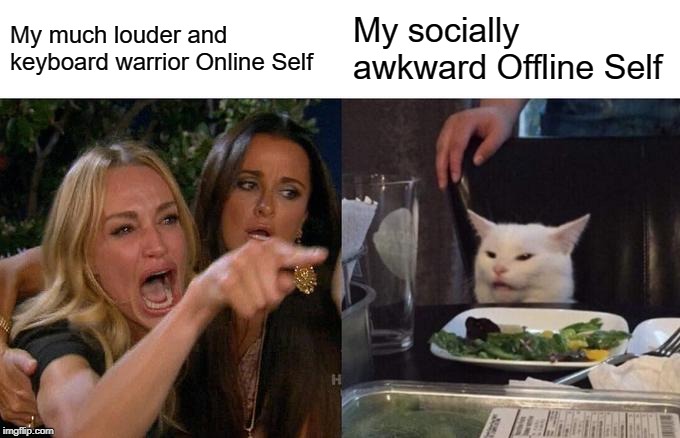
This meme combines and contrasts both my Online Self and Offline Self
The left panel depicts a screaming and presumably angry woman, which is what I think to be most similar to how I am online. What I mean by this that in the Online Space, I am very loud and outgoing about my ideas, opinions and feelings about various subject matters such as politics, the environment, economics, fake news and that I am not afraid to express how I feel about said topics though it is not only limited to those, I think that the woman depicts how I am in general when I’m on the internet. This is probably because of how limited I am when it comes to expressing myself in the offline sphere, which explains the right panel. A cat is shown to have a rather awkward and ridiculous face and somewhat quiet vibe in comparison to the woman on the left. This shows how I am offline, or in real life situations. I find myself unable to say my true feelings to others, or if I do attempt to, I end up looking weird or ridiculous. The meme hopes to show the contrast of my more aggressive online self versus my more awkward and gentle offline self.
City Boy
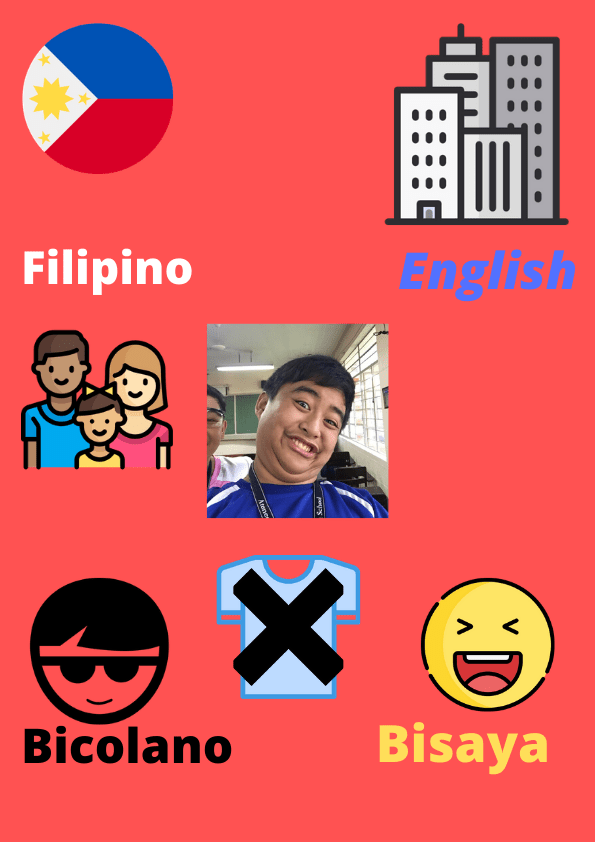
Even with the provincial backgrounds of my parents, for as long as I can remember, I have been living in the city my entire life. I was born in Mandaluyong, lived in Cainta for around 9 years and have been living in Quezon City for the past 9 years. Living in the city entailed that the people I normally interact with also came from and was accustomed to the city life. A major factor in growing up in the city would be the prevalence of English when talking with other people, especially in the school setting or even out with friends, though this does not necessarily mean that Filipino was completely overridden.
Bicolano
My father Originally came from Bicol and so from time to time, we would go there to visit some relatives. And during those visits, my dad would primarily talk in Bicolano along with our relatives and as a kid, I was not able to fully understand most of what they were saying. Eventually, through inferring and context clues, I picked up the meaning of some phrases and words, some were right and some were not. Occasionally, while eating together at the table, my dad would also talk in Bicolano and as I grew older, I found that even though I may not know the exact translation of those words, I understood what my father was saying without having to think about the words he used. My Bicolano side is more of a rough kind of personality, rough in the manner of speaking, rowdy in interacting with others, etc which I got from cousins there, this of course took some time in adjusting.
Bisaya
Like my father, my Mom also came from the province, specifically General Santos City. The case with her is very similar with my Dad. When we’d get the chance to, we would visit our Grandparents and cousins back in Gensan and as you’d expect, our relatives there spoke to us in a mix of Bisaya and Filipino. I eventually picked up these words and started using some of them at home. It was also very common for my Mom to speak in Bisaya at home and so to some degree, I am able to understand people when they speak in Bisaya given that there are enough context clues. My Bisaya side is more of a ‘joker’ and really values the presence of relatives.
Filipino
Out of all my identities, the one that I would say is engaged at all times regardless if I’m in the city or province would be my Filipino-self. This would pertain to the common behaviors present in most if not all Filipinos, like camaraderie, being hospitable to guests, strong ties with the family and to religion, our ‘hugging’ culture, and certain actions that we do such as using our lips to point, ‘pagmamano’, and among other things within the Filipino culture.
How are my identities congruent with one another?
Being somewhat exposed to Visayan and Bicolano culture throughout the years, I think that I’m able to encompass both identities at the same time when eating with my family. Like I mentioned before, both my parents use their provincial tongues when speaking to us at the table, and because of my upbringing in both cultures, I am able to understand both of them, even their tones. By tones I mean that I can decipher whether they are being sarcastic, serious, or trying to make a joke, which is slightly varied from how it would sound like if it was in Filipino or in English. This hybridity is especially useful at family gatherings wherein relatives from both sides come together. Naturally, I would have to ‘mano’ to all the elderly, uncles, aunties, even family friends which goes back to my Filipino culture of showing respect and importance to family members. There would be separation between the two groups, and it is at those times that I am able to switch between my Visayan and Bicolano identities when speaking to a particular group of relatives. Another instance wherein I am able to combine my identities would be when it comes to food. Being exposed to different dishes of different cultures, I would’t say that I am able to ‘adjust’ my taste buds, but rather I am able to accept and appreciate both cultures in terms of their food. Essentially, I am able to combine both my Visayan and Bicolano side under one identity, my ‘Provincial’ self. I am also able to utilize this ‘provincial’ identity when speaking to certain people at school. Whenever I hear people, more commonly the dormers who came from the provinces, speak in their native tongue (Most are visayans, only a few are bicolanos) , I feel a sense of camaraderie and belongingness with them. This is somewhat related to the Filipino culture of ‘pakikisama’ and ‘makabayan’ which is common among Filipinos who meet abroad or places outside of their homes and feel a sense of familiarity with each other.
How are my identities at odds with each other?
I think that my two identities that most frequently clash with one another would be my City Boy and Provincial identity. This is because growing up in the city, I have grown accustomed to the certain actions and practices that do not coincide with some beliefs I learned during my visits to Bicol and Gensan. An example of this would be the act of spitting on the ground. During my time in the provinces, it was common for people along with my relatives to spit on the road, grass, anywhere outside their home and they saw this as a mundane thing. They did not see anything wrong with this and was widely accepted by most. This however, contradicts with my upbringing in the city. In the city, this act would be seen as unhygienic and rude and being raised there my whole life, I have a natural bias against spitting in public. Another practice that was common in the province was the act of being shirtless. Probably because of significant lack of air conditioning back at the province, more people were more likely to take of their shirts whether at home or outside (this applied only to men). Again I saw this practice being done by my uncles and cousins. This however, is less common and somewhat frowned upon in the city especially in public areas. Another instance where the two identities collide would be when I’m talking with people who grew up in the city with little to no knowledge about the Visayan or Bicolano language. Since I am accustomed to speaking in broken Filipino-Bicolano-Bisaya at home, I sometimes have ‘slips’ when talking to company where I insert certain provincial words or slang and it ends in confusion.
Today, as I unwillingly woke up from my sleep, the first thought that came to mind was to check my phone and see if I got any messages from Malaika. She is my girlfriend, and no I am not trying to flex, I just really want to emphasize how lucky I am to have her in my life. It is not an exaggeration when I say that one of the main reasons I get up in the morning is because of Malaika and yes, it’s cheezy, I know. I’m very thankful that I wake up everyday knowing that she’ll be there to get me through life, through homework, academics, personal problems, whatever it may be. And so I’d also like to thank the mysterious force called love that brought us together.
Though it may seem very cliche, I’m very thankful for having a house with more space than what I need, an actual bed I can sleep on, and a roof to shield me from the confusing alternation of rain and heat of the Philippines.
Often taken for granted, food is a very basic and essential part of our lives. I am very thankful for the privilege of eating what I food I want, when I want to. This is because even though food is supposed to be a basic necessity, many of us today still don’t have the luxury of having food on the table, much less food in their stomachs. Many are still in the status of surviving, not living.
Around the time when the positive affect activity was given out, I was not really close with my block. I had a few friends, but of course being college, they weren’t always there as they had their own things to attend to. It was during and after the positive affect activity that I felt more comfortable and much happier with my block. I felt that even a little, I, together with my group, was able to break the ice with most of the members of my block and that made all the difference.
I think that by being ‘present’ at that moment or in a way, more aware of what was happening during the activity, I came to realize that being positive can come naturally and often overrides negative thoughts, which was the case for me. While we were passing out Flattops and making jokes with one another, with strangers, I wasn’t thinking about my isolation from the block or anything bad for that matter, and I’d like to think that neither did my blockmates. I also came to realize that while the activity was only temporary along with the positivity it brought, the same was the case for my negative thoughts.
Overall, the activity made me realize that going out of my comfort zone can bring about positivity, especially if the zone I entering exhibits positivity. It also solidified my understanding of Barbara Fredrickson’s idea that people who are more extraverted tend to be happier because they spend more time with others. The activity allowed me to broaden my relationships and sociability with other people and by doing so, allowed me to have to have positive thoughts and later on these thoughts were concretized into actions.

 Chavit's Blog